
Free chapter · Your First 90 Days in Brazilian Jiu-Jitsu
Your First Class, Minute by Minute
Nervous about your first Brazilian Jiu-Jitsu (BJJ) class? Here's what it really feels like, from the parking lot to the shower. No techniques, just the stuff nobody tells you.
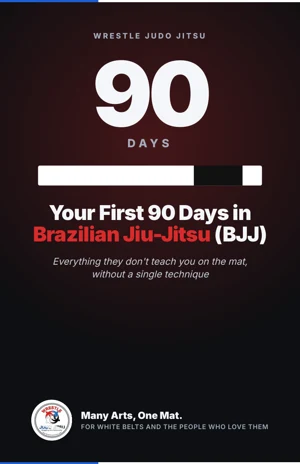
This is Chapter 5 of our book, Your First 90 Days in Brazilian Jiu-Jitsu (BJJ). Choosing a gym, the unwritten rules, tapping and safety, the week-four slump and more. Without a single technique.
Out now on Amazon (paperback, 93 pages).
Get the book on AmazonThis chapter follows you through one ordinary first class, from the parking lot to the shower. Every gym is a little different, but the shape of the evening is almost always the same.
6:40 pm. The parking lot
You're early. Good. You sit in the car for a minute longer than you need to. Through the window of the gym you can see people in white and blue jackets laughing, stretching, slapping hands. They look like they've been doing this since birth.
You check your bag for the third time. Water, flip-flops, spare shirt. Your nails are so short they almost hurt. You think about driving home. Nearly everyone thinks about driving home.
You get out of the car.
6:43 pm. The door
The door is heavier than you expected, or maybe your arm just feels weak. Inside, it smells of clean mats and something like laundry. Somebody at the front desk looks up and smiles.
"First time?"
You nod. You say your name. They hand you a form, the waiver, and a pen that doesn't quite work. You tell them about the knee you hurt playing football ten years ago. They write it down and say, "Thanks, I'll tell the coach." Nobody laughs. Nobody thinks less of you. You've just made your evening safer.
6:48 pm. The bag
They show you where to change. There's a shelf of shoes by the edge of the mat. You put yours there, and you notice that nobody has walked on the mat in shoes. You slip into flip-flops.
The changing room is a small space with too many people in it. Somebody says "Hey" and moves their bag so you can sit. If you're borrowing a gi, someone shows you how to tie the belt. It takes three tries. It always takes three tries.
6:55 pm. The introductions
You step onto the mat. It's softer than you thought and slightly warm. A tall person with a brown belt walks over, offers a hand and says their name. You forget it instantly. That's fine. You'll hear it again.
Then the coach comes over. "Welcome. Did you tell the front desk about your knee? Great. Tonight, just copy what the others do, and tell me if anything feels wrong. You won't roll hard tonight." Something in your shoulders lets go a little.
7:00 pm. The line-up
Someone calls "Line up!" and everyone moves at once. You freeze, then spot the other white belts gathering at one end and join them. You copy the bow. You're slightly late. Nobody notices.
7:02 pm. The warm-up
You jog in a circle. Fine. Then side steps, then something with your knees high. Fine. Then everyone drops to the floor and starts scooting backwards on their sides like caterpillars. This is "shrimping". You do it badly. You go sideways when everyone else goes straight. The person next to you says, quietly, "Push with this foot," and points. You try. It's a bit better.
Forward rolls. Backward rolls. Your head spins. Somebody says, "Breathe out on the way over." It helps.
Then it's over. You're sweating. You've been here twelve minutes. This is your moment to remember: the warm-up is the hardest part of your first night, because it's the part where you feel most watched. It gets easier the second time. Much easier by the fifth.
7:15 pm. The technique that makes no sense
The coach calls everyone round in a semicircle and kneels down with a senior student. "Tonight, we're working from here."
What follows takes about four minutes. The coach shows a move. Then shows it again, slower. Then explains why the hand goes there and not there. You watch carefully. You understand every single step while it's happening. Then the coach says, "OK, pair up," and you realize you have no idea what you just saw.
This is completely normal. Every beginner experiences it. Your brain hasn't got anywhere to put the information yet. That comes with time.
7:20 pm. Drilling: the "copy your neighbor" protocol
The coach pairs you with a blue belt. This is a gift. Blue belts are close enough to the beginning to remember how confusing it is.
Here's the protocol that will carry you through your first month:
- Say "I'm new." Your partner will slow down and explain.
- Watch the pair next to you. If you're lost, copy them.
- Do it slowly. Speed is not the goal. Getting the steps in the right order is.
- Ask "Which hand?" It's the most common question in jiu-jitsu, and nobody minds it.
- When your partner does it to you, let them. Drilling is cooperative. You're helping each other learn.
You do the move ten times. The first three are a mess. By the eighth, you get it roughly right. Your partner says, "That's it." Then the coach changes something small and you lose it again. That's fine too.
7:40 pm. The first roll
The coach calls "Last part: rolling." Your stomach drops.
Maybe tonight you won't roll at all. Many gyms let newcomers watch, or roll gently with one senior student. If you do roll, here's what usually happens.
A purple belt walks over. "Want to do a light one? I'll go easy." You slap hands, bump fists. You both start on your knees, which is the most common way to begin with beginners.
How to start. Reach for their collar, or their arms. Try to stay balanced. Don't grab and squeeze with everything you have. You'll do it anyway. Everyone does.
How to survive. Within twenty seconds you're on your back with a person on top of you who weighs about as much as a sofa. Your instinct says push. Pushing with straight arms will tire you out and won't move them. Instead: breathe. Keep your elbows close to your body. Protect your neck by keeping your chin down. You don't need to escape. You just need to stay calm.
When to tap. Your partner's arm slides across your neck. You feel pressure. Not pain yet, just pressure. That's your signal. Tap now. Pat their body or the mat, two or three clear times, or say "tap". They let go instantly. They nod. "Good tap."
You get a second chance. The same thing happens a slightly different way. You tap again. Five minutes feel like twenty. When the timer goes, you're lying on your back breathing like you've run a mile. Your partner slaps your hand and says, "Nice. You stayed calm." You did.
7:58 pm. The line-up, again
Back in line. A bow. Maybe the coach says a few words: a date for a seminar, a reminder to wash gear. Then the class breaks up. People shake hands with everyone they trained with. Do the same.
The coach finds you. "How was it?" Be honest. If something hurts, say so now. If you loved it, say so. If you're not sure, say that.
8:05 pm. The walk out
You put on your flip-flops at the edge of the mat. Your forearms ache in a strange new way. Your neck feels like it's been through something. Your hair is a mess.
You realize you haven't thought about work, money or anything else for an hour. That's the hook. That's the thing nobody can explain before your first class, and everyone understands after it.
8:30 pm. The shower
Straight home, straight in the shower. Clothes in the wash. Look at your arms: maybe a few red marks from grips. Look at your knees: maybe a bit of mat burn.
You'll probably be tired but wired, and you might not sleep straight away. Chapter 7 explains why, and what to try.
Before you sleep, do one more thing: decide when you're going back. Put it in your calendar. The second class is the one that counts. That's when it stops being a thing you tried and starts being a thing you do.
What if...
...I feel sick or dizzy during class? Stop. Sit at the edge of the mat, breathe slowly, sip water and tell the coach. Pushing hard on your first night is a common cause of feeling unwell, and it's nothing to be embarrassed about. If you feel very unwell, or the feeling doesn't pass, get medical help.
...nobody pairs with me? Raise your hand and look at the coach. They'll pair you up. It happens to everyone, often because people simply didn't see you.
...I think I hurt my partner? Stop immediately and ask, "Are you OK?" Tell the coach if they're not. Accidents happen. What matters is how you respond.
...I'm late? Say sorry to the coach, warm up at the edge of the mat, and wait to be told to join in. Don't walk through the middle of a demonstration.
...I laugh, swear, or get emotional? All normal. Jiu-jitsu is intense. Adults have cried after first rolls, laughed through warm-ups and sworn at shrimping. Nobody minds.
...I don't like it? Give it three classes before you decide. The first class is the strangest. If you still don't like it after three, try another gym before you give up on the sport. If you still don't, at least you'll know.
Takeaway: your first class in seven lines
- Arrive early and tell the coach about any injury.
- Copy the person next to you in the warm-up.
- Say "I'm new" to every partner.
- Don't worry if the technique disappears from your head. It will come back.
- In rolling: breathe, elbows in, chin down.
- Tap at pressure, not at pain.
- Book the second class before you go to sleep.
Liked this chapter? The other 14 cover choosing a gym, the unwritten rules, tapping and safety, the week-four slump and more. Get the book on Amazon.
This chapter does not give medical advice. Every gym is different: your coach has the final word on their mat, and your doctor has the final word on your body.
Questions about your first class? Ask the community at r/WrestleJudoJitsu.